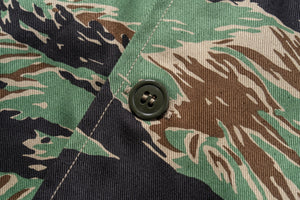
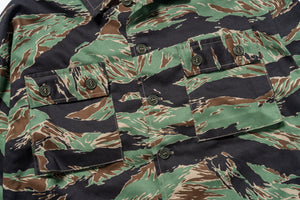
The origins of Tiger Stripe camouflage trace back to the French 'lizard' pattern, also known as Tenue du Léopard. The pattern is often credited to the Vietnamese, due to the Republic of Vietnam Marine Corps making subtle changes to the lizard camouflage and using it to reflect the thick jungle conditions and intense tropical heat of Vietnam, by incorporating bold black stripes over shades of green and brown.
★ ★ ★
The Tiger Stripe pattern gained significant recognition during the Vietnam War when it was unofficially embraced by the U.S. Armed forces. Many young servicemen opted for the Tiger Stripe over the official issue ERDL pattern. USMAAG advisors were even authorized to wear the combat uniform of their Vietnamese units, leading to the production of many uniforms by local tailors. This diversity in production explains the myriad variations seen in the pattern.
★ ★ ★
The pattern known as John Wayne Dense (JWD) is one of the most recognisable of all tiger stripe variations. The name itself derives from its association with John Wayne, who is believed to have worn garments in this pattern in the film The Green Berets, though it is also referred to by collectors as “Okinawan” or “Classic.” It is generally believed to have been produced in Japan, likely centered around Okinawa, for use by South Vietnamese forces and CIDG units during the early to mid-1960s.
★ ★ ★
Its origins can be traced back to the late 1950s, when tiger stripe camouflage emerged as a regional adaptation of the French lizard pattern. First developed around 1957, these early designs translated the directional brushstroke character of lizard camouflage into a more fragmented, high-contrast layout suited to dense jungle environments. The JWD variant represents one of the earliest and most defined expressions of this evolution.
★ ★ ★
Visually, the pattern is characterized by bold black striping layered over a ground of dark green and muted brown, with subtle tan elements breaking up the composition. Compared to later variants, the arrangement appears dense and tightly packed, giving the pattern its “Dense” designation.
★ ★ ★
- Printed Camouflage, 100% Cotton Twill Fabric
- Urea Buttons
- Cotton Sewing Thread Construction
- Made in Japan